 ultimate-guide
Why American Made Planters Last: 2026 Durability Guide
Table of Contents
- Why American Made Planters Outlast Imports
- Resin vs. Cedar vs. Ceramic: Which Material Lasts?
- How to Choose Long-Lasting Plant Pots
- Plastic vs. Ceramic Planters Durability: A Side-by-Side Look
- Weather Resistance, UV Protection, and Freeze-Thaw Survival
- Where to Buy American Made Plant Saucers and Planters
- Frequently Asked Questions
Last Updated: September 17, 2026
Why American Made Planters Outlast Imports
Thin walls, low-density resin, and skipped UV stabilizers all shorten service life, which is why american made planters tend to hold up longer in real outdoor conditions. This guide from Beloit Plastics LLC shows you how to shop for planters that survive winter after winter.

The core difference comes down to material density and wall thickness. Imported planters are often built to hit a shipping weight target, not a durability target. Domestic manufacturers answer to different economics: shorter supply chains and tighter quality control.
A common mistake is judging a planter by how it looks on day one. A planter's real test is what it looks like after three freeze-thaw cycles.
Material Density and Wall Thickness
Material density is the mass of plastic per unit of volume, and it directly determines how a planter handles impact, load, and temperature swings. Higher-density polypropylene resists cracking because there is simply more polymer structure holding the wall together.
Wall thickness works the same way. A thicker wall distributes the weight of wet potting soil and resists bowing under load. Thin walls flex, and flexing plastic eventually cracks at the stress point, usually right at the base or rim.
Beloit Plastics LLC molds its planters and saucers from 95% recycled high impact polypropylene, a material chosen specifically for impact resistance and color retention. That combination is what separates a planter that lasts several seasons from one that lasts one.
Plastics Industry Association overview of polypropylene properties
Resin vs. Cedar vs. Ceramic: Which Material Lasts?
Resin-based planters can be a durable option in many outdoor settings, especially where temperatures swing hard between freezing and thawing. Each material fails through a different mechanism, and understanding those mechanisms can help you choose which one survives your conditions.
Resin-based planters are molded from long-chain polymers. High-density, high-impact polypropylene packs more polymer chains into the same volume, which spreads impact energy across the wall instead of concentrating it at a single point. That is why a quality resin planter absorbs a dropped bag of soil while a thin one spider-cracks. Resin resists moisture outright, holds color when UV-stabilized, and needs no sealing. The trade-off is that very cheap resin, the thin, low-density kind, behaves nothing like commercial-grade material.
Cedar-wood planters rely on naturally occurring oils that resist rot. The failure mode is different: cedar is porous, so it absorbs water into the wood cells. Repeated wet-dry cycles swell and shrink those cells until the grain separates and splits. Cedar also weathers to gray and benefits from annual sealing to slow that process. Its real advantage is thermal insulation, since wood buffers root-zone temperature swings better than a thin plastic wall.
Ceramic planters are fired clay, which is rigid and brittle. Rigid materials do not flex under stress; they fracture. A ceramic pot that holds trapped water is the classic freeze-thaw casualty, because expanding ice has nowhere to go and the wall cracks. Ceramic also absorbs moisture into its body, and that absorbed water expands in a freeze. The upside is unmatched moisture retention and appearance in sheltered spots.
| Material | Lifespan Outdoors | Maintenance | Freeze-Thaw Resistance | Failure Mode | Best For |
|---|---|---|---|---|---|
| Resin-based (high-density) | Several seasons or more | Rinse and wipe | High | Gradual, if any | Patios, balconies, decks |
| Cedar-wood | Moderate, with sealing | Annual sealing | Moderate | Grain splitting | Raised beds, rustic setups |
| Ceramic | Variable, crack-prone | Handle with care | Low | Sudden fracture | Sheltered entries, indoors |
A useful way to think about it: resin can offer a long service life, cedar can last predictably with maintenance, and ceramic can fail suddenly. If you want a long service life with minimal attention, high-density resin can be a practical pick. If you want the look of ceramic, keep it out of standing water and out of hard freezes.
How to Choose Long-Lasting Plant Pots
Choosing long-lasting plant pots comes down to five checks you can run before you buy.
- Check wall thickness. Squeeze the rim. If it flexes easily, the wall is too thin for outdoor use.
- Confirm UV stabilization. Ask whether the material is fade-resistant and UV-resistant. Unstabilized plastic chalks and embrittles in direct sun.
- Look at the drainage system. Proper drainage holes prevent root rot and stop water from pooling at the base, which is what drives freeze damage.
- Size the saucer correctly. Measure the bottom diameter of the pot, then choose a saucer roughly 2 inches larger.
- Verify where it was made. Domestic production shortens the supply chain and makes quality control easier to enforce.
Beloit Plastics LLC sizes its saucers from 3 inches up to 21 inches, which makes it straightforward to match a saucer to nearly any pot you already own.
Austin Planter 18 Inch (16.3 Inch Base) →
Plastic vs. Ceramic Planters Durability: A Side-by-Side Look
Plastic can offer durability in many outdoor scenarios, while ceramic can offer appearance in sheltered spots. The comparison is less about which material is "better" and more about which failure mode you can live with.
Ceramic fails suddenly. A crack appears, and the pot is done. High-density plastic can fail gradually at worst, and a quality resin planter can show no meaningful failure at all across several seasons of weathering.
Weight is the other practical factor. A large ceramic planter can be difficult to move once planted, which matters on a balcony where you reposition pots for sun. Resin-based planters stay light enough to handle but heavy-duty enough to hold a large, fully watered plant without bowing.
- Impact resistance: plastic absorbs knocks; ceramic chips and shatters
- Moisture behavior: plastic ignores standing water; ceramic absorbs it
- Thermal insulation: ceramic and cedar insulate roots better than thin plastic
- Long-term investment: high-density plastic spreads its cost across more seasons
University of Illinois Extension guide to container gardening
Weather Resistance, UV Protection, and Freeze-Thaw Survival
Freeze-thaw cycles are the single hardest test a planter faces, and the material's structural integrity decides whether it passes. Water seeps into any microscopic crack, freezes, expands, and widens that crack a little more each time. Over one winter, a marginal planter becomes a broken one.
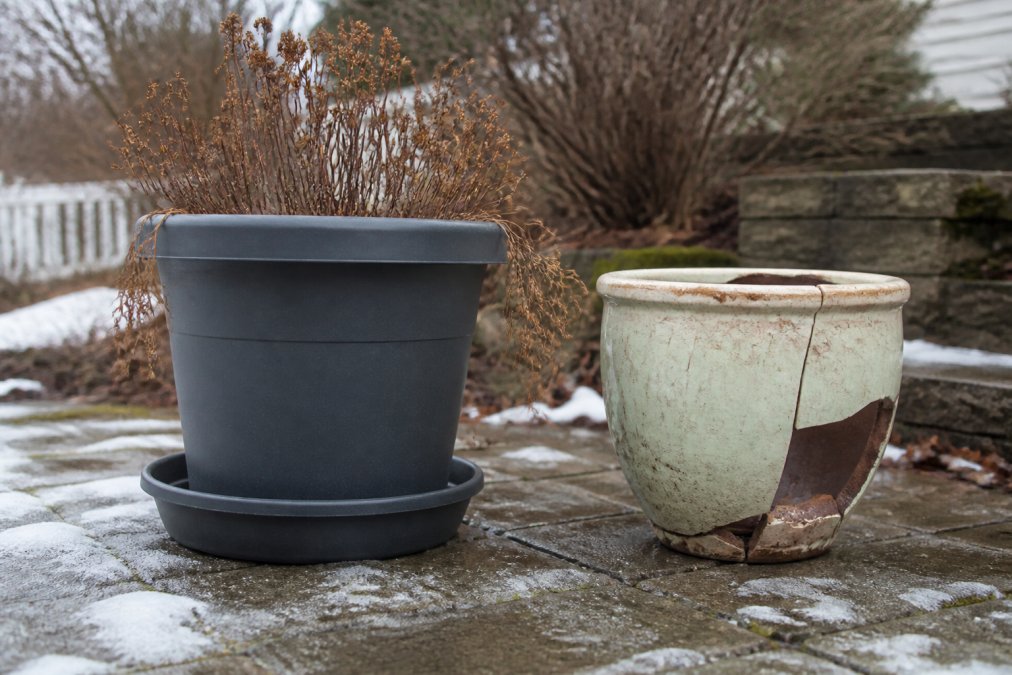
What most buying guides skip is how manufacturing choices change that outcome. A double-wall or ribbed-wall construction adds a second load path, so stress from expanding ice and the weight of wet soil is distributed instead of concentrated at the base or rim. Wall thickness matters for the same reason: a thicker wall resists bowing under load, and a wall that does not flex does not fatigue. UV stabilization is a formulation choice, not a coating. Manufacturers load the polymer with UV stabilizers during compounding, so protection runs through the entire wall rather than sitting on the surface where it can wear away.
UV protection is the slower killer.
Matching the Material to Your Regional Climate
Performance is not one-size-fits-all. The conditions that break a planter in one region are different from the ones that break it in another, and the right material changes with them.
- Humid, hot summers (Southeast, Gulf Coast): The dominant threats are UV intensity and constant moisture. High-density, UV-stabilized resin wins here because it ignores standing water and holds color. Cedar can rot faster in sustained humidity, and ceramic stays wet against its own body.
- Hard freeze-thaw cycles (Upper Midwest, Northeast, Mountain West): The dominant threat is expanding ice. High-density resin that flexes instead of fracturing is the safest pick. Ceramic is the highest-risk choice, and any pot that holds trapped water is a candidate for cracking.
- Dry, high-altitude sun (Southwest, Rockies): UV degradation and wide day-night temperature swings drive failure. UV-stabilized resin resists chalking, while unstabilized plastic embrittles quickly.
- Mild, wet winters (Pacific Northwest): Rot and moss are the issues. Resin resists both; cedar needs sealing to slow moisture uptake.
Where to Buy American Made Plant Saucers and Planters
You can buy american made plant saucers and planters directly from domestic manufacturers, which usually means better pricing and faster shipping than a retail middleman. Buying direct also gives you a clear answer on material and origin, two things big-box listings often leave vague.
U.S. Environmental Protection Agency resources on recycled materials
Frequently Asked Questions
What type of planters last the longest?
American made planters molded from high-impact polypropylene tend to outlast most alternatives. The material resists UV fading, cracking from freeze-thaw cycles, and moisture damage that breaks down clay and untreated wood. Beloit Plastics uses 95% recycled high-impact polypropylene in its Austin Planter line, which holds up across seasons indoors and outdoors. Thicker walls and ribbed undersides add structural integrity that cheap imports often skip.
How do I know where to buy American made plant saucers that actually hold up?
Buying direct from the manufacturer is the most reliable route. Beloit Plastics sells its Austin Planter saucers straight from its Beloit, Wisconsin facility, so you skip middlemen and get full transparency on materials. Look for listings that state the recycled content, the wall thickness, and the country of origin. A saucer sized about 2 inches larger than your pot's base diameter gives adequate water storage without overflow.
In plastic vs. ceramic planters durability, which one wins?
Plastic can offer outdoor durability in many U.S. climates. Ceramic looks elegant but can chip, crack in freeze-thaw cycles, and is heavy to move. High-impact polypropylene resists impact, UV fading, and moisture without the brittleness of clay or glazed ceramic. Ceramic still works well for indoor display where temperatures stay stable. For patios, decks, and balconies exposed to weather, resin-based plastic can be a practical long-term investment.
Why is domestic manufacturing better for garden product quality?
Domestic production keeps quality control close to the source. Manufacturers like Beloit Plastics can inspect material density, wall thickness, and drainage hole placement before products ship. Shorter supply chains also mean faster replacement if something fails, and you can verify the recycled content claim directly with the maker.